
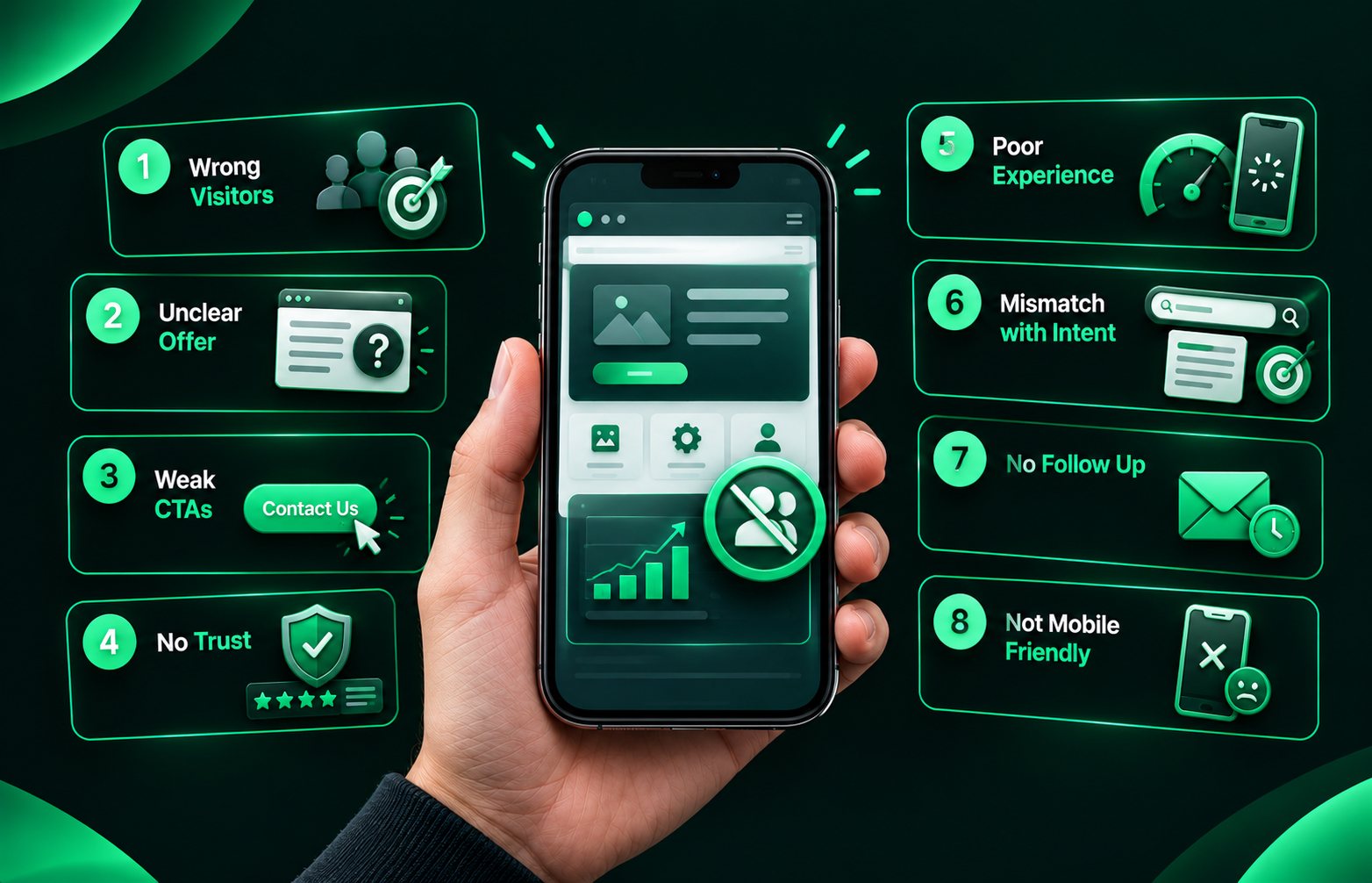
Why Does Your Website Get Traffic but No Customers? 8 Common Reasons
Getting visitors to your website is an important step for any business, but website traffic alone does not guarantee business growth. If your website receives hundreds or even thousands of visitors but generates very few enquiries, calls, bookings, or sales, something may be preventing those visitors from becoming customers.
The problem may involve targeting the wrong audience, unclear messaging, weak calls to action, a lack of trust, or a poor user experience. Understanding these issues is the first step toward turning your existing website traffic into meaningful business results.
1. You’re Attracting the Wrong Visitors
Your website may receive plenty of traffic but still fail to generate customers if the visitors are not interested in your products or services.
This often happens when a website targets broad keywords that attract people looking for general information rather than potential customers ready to take action.
For example, a business offering SEO services in Kerala may attract more relevant visitors by targeting phrases such as “SEO services in Kerala,” “hire an SEO specialist,” or “digital marketing agency in Kerala.”
How to fix it:
Research keywords that match your products, services, and target audience.
Understand the search intent behind the keywords you target.
Create content that addresses the needs of potential customers.
Focus on attracting qualified visitors rather than increasing traffic numbers alone.
The goal is to bring people to your website who are genuinely interested in what your business offers.
2. Your Website’s Offer Isn’t Clear Enough
When visitors land on your website, they should quickly understand what your business does, whom you help, and why they should choose your services.
If your homepage contains vague headlines, confusing descriptions, or too much unnecessary information, visitors may leave without understanding your value.
For example, a headline such as “Welcome to Our Website” tells visitors very little about your business. A more specific headline explaining your service and the customers you help can communicate your value more effectively.
How to fix it:
Write a clear headline that explains your primary offer.
Describe your services in simple, customer-focused language.
Highlight the main benefits of working with your business.
Make essential information easy to find.
Use relevant images and examples to support your message.
A clear value proposition helps visitors understand whether your business is the right solution for their needs.
3. Your Website Doesn’t Have Strong Calls to Action
Even visitors who are interested in your services may leave without contacting you if they do not know what to do next.
Calls to action (CTAs) guide visitors toward the next step, whether that means requesting a quote, booking a consultation, calling your business, or submitting an enquiry.
Without clear CTAs, your website may attract potential customers but fail to turn their interest into action.
How to fix it:
Add clear buttons such as “Get a Free Quote,” “Contact Us,” or “Book a Consultation” where appropriate.
Place CTAs on important service pages and landing pages.
Make buttons easy to identify on desktop and mobile devices.
Use action-oriented language that explains the next step.
Ensure your contact forms and booking links work correctly.
Choose CTAs that match your business model and the stage of the customer’s decision-making process. Avoid overwhelming visitors with too many competing options.
4. Your Website Doesn’t Build Enough Trust
People are often cautious about spending money or sharing personal information with a business they do not know. If your website provides little evidence of credibility, potential customers may hesitate to contact you.
A lack of reviews, unclear business information, outdated content, or limited examples of previous work can make it harder for visitors to feel confident in your services.
How to fix it:
Display genuine customer reviews and testimonials.
Showcase relevant projects, case studies, or examples of your work.
Provide accurate business and contact information.
Explain your services, process, and pricing where appropriate.
Keep your website design and content professional and up to date.
Include relevant qualifications, certifications, or awards where applicable.
Trust signals help visitors evaluate your business and make more informed decisions. Only use genuine testimonials and verifiable claims.
5. Your Website Experience Is Poor
A website can attract the right audience and offer valuable services but still lose potential customers because of a frustrating user experience.
Slow-loading pages, confusing navigation, broken links, intrusive pop-ups, and poor mobile usability can make it difficult for visitors to find information or contact your business.
How to fix it:
Improve page loading speed and overall performance.
Make your website responsive across mobile devices, tablets, and desktops.
Simplify navigation so visitors can easily find important pages.
Fix broken links, buttons, and forms.
Use readable fonts, clear headings, and sufficient contrast.
Make contact details and enquiry options easy to locate.
A smooth browsing experience reduces unnecessary obstacles and helps visitors move naturally from exploring your website to contacting your business.
6. Your Landing Pages Don’t Match Search Intent
Visitors may leave your website if the page they land on does not match what they expected to find.
For example, someone searching for “SEO services in Kerala” may expect a page explaining your SEO services, process, benefits, and service area. If they land on a generic homepage with little relevant information, they may return to Google and choose another result.
How to fix it:
Create dedicated landing pages for your main services.
Match page content to the keywords and search intent you target.
Explain your services, benefits, process, and relevant experience.
Include a clear CTA on each important landing page.
Use relevant internal links to help visitors explore related services.
Keep the information consistent between your search result and landing page.
Relevant landing pages create a more focused experience and help potential customers find the information they need to make a decision.
7. Your Conversion Process Is Too Complicated
Sometimes visitors are ready to contact your business but abandon the process because it requires too much effort.
Long enquiry forms, unnecessary required fields, confusing booking systems, or difficult-to-find contact information can prevent interested visitors from completing an enquiry.
How to fix it:
Keep enquiry forms short and straightforward.
Request only the information you genuinely need.
Make phone numbers, email addresses, and contact links easy to find.
Simplify booking and consultation processes.
Display clear confirmation messages after successful form submissions.
Test your forms and contact options regularly on mobile and desktop devices.
The easier you make it for potential customers to take the next step, the fewer unnecessary barriers they encounter during the conversion process.
8. You’re Not Tracking Website Conversions
Website traffic is useful, but it does not tell you whether your marketing efforts are generating enquiries or sales.
Without conversion tracking, you may know how many people visit your website but have little insight into which pages, campaigns, or channels produce valuable business results.
How to fix it:
Set up Google Analytics 4 to measure relevant website activity.
Track important actions such as enquiry submissions, bookings, and purchases.
Configure conversion events for meaningful customer actions.
Use Google Search Console to review search impressions, clicks, and organic search performance.
Identify which landing pages generate enquiries and which need improvement.
Review your data regularly and test changes to your website.
Tracking conversions helps you make evidence-based decisions about SEO, advertising, content marketing, and website improvements.
What Should You Do First?
If your website receives traffic but generates very few customers, start by reviewing the following areas:
Check whether your visitors match your target audience.
Make your services and value proposition clear.
Add visible and relevant calls to action.
Improve trust signals and website credibility.
Fix usability issues and improve the mobile experience.
Align landing pages with search intent.
Simplify enquiry forms and contact processes.
Set up conversion tracking and monitor results.
Start with the issues most likely to prevent visitors from becoming customers. Use website analytics, customer feedback, and conversion data to identify where improvements are needed instead of making changes based on assumptions.
Turn Your Website Traffic Into Customers
Your website should do more than attract visitors. It should help potential customers discover your business, understand your services, build confidence in your brand, and take the next step.
At abhinavnarayanan.in, you can explore digital marketing services including SEO, content marketing, social media marketing (SMM), email marketing, graphic design, and web development.
If your website is attracting visitors but not generating enough enquiries or sales, focus on identifying the actual problems affecting your conversion rate. Combining an effective SEO strategy with a well-optimized website can help you get more value from your existing traffic.
Ready to improve your online presence? Visit abhinavnarayanan.in to explore digital marketing services and get in touch.