
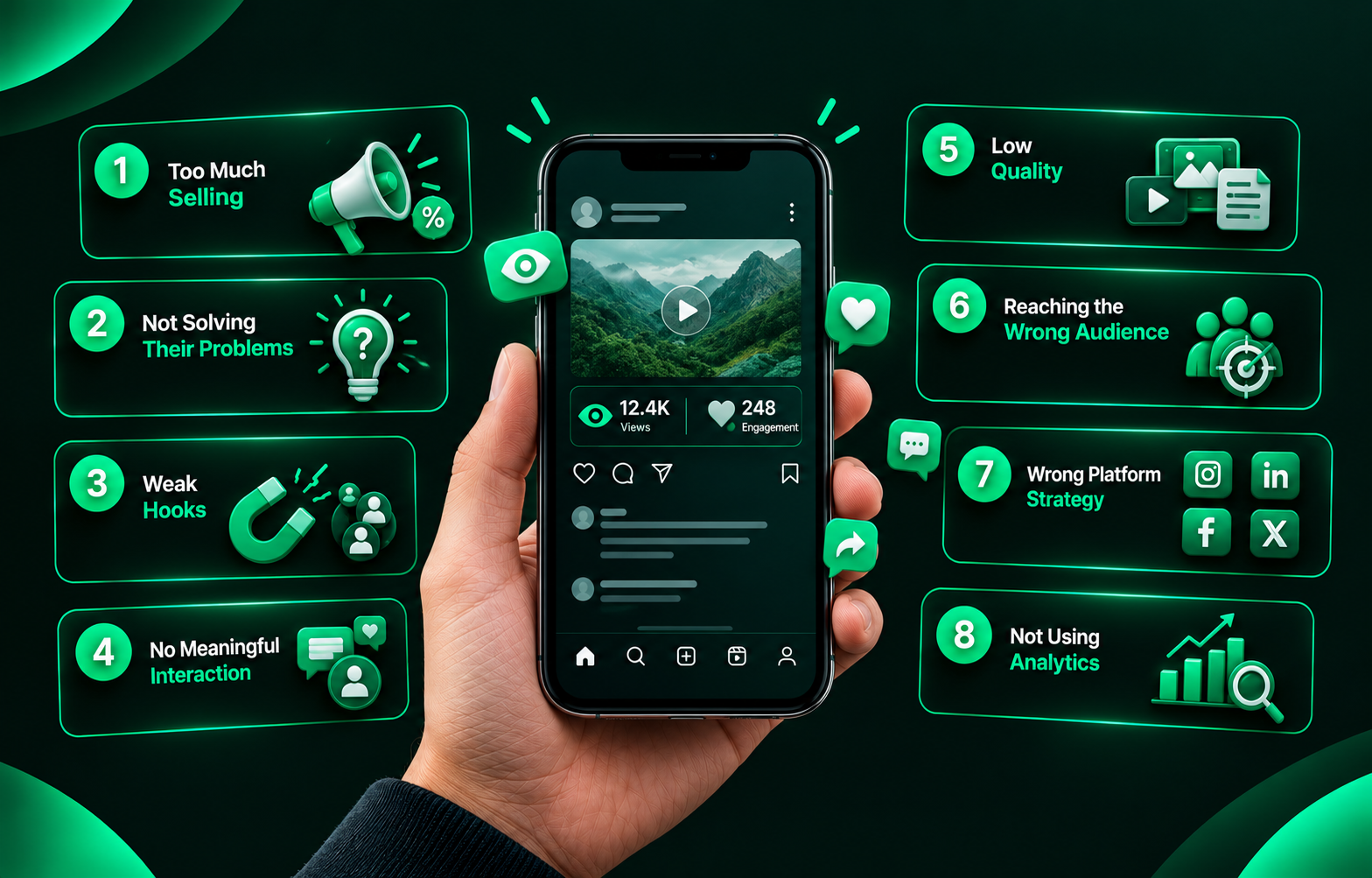
Why Do Your Social Media Posts Get Views but No Engagement? 8 Common Reasons
Getting views on social media is a good start, but views alone do not guarantee meaningful engagement or business growth. If your posts reach hundreds or thousands of people but receive very few likes, comments, shares, or saves, your content strategy may need improvement.
The problem could involve promotional content, weak hooks, irrelevant topics, the wrong audience, or a mismatch between your content and the platform. Understanding these issues can help you create more engaging posts, build stronger audience relationships, and improve your social media marketing results.
1. Your Content Is Too Focused on Selling
One of the most common reasons social media posts receive views but little engagement is that they feel too promotional. If every post asks people to buy a product, book a service, or contact your business, your audience may lose interest over time.
People use social media to discover useful information, learn new things, find entertainment, and connect with topics they care about. Your content should provide value beyond promoting your business.
How to fix it:
Share practical tips and educational content related to your industry.
Publish behind-the-scenes posts that help people understand your business.
Share genuine customer experiences, projects, and success stories.
Create content that answers common questions.
Balance promotional posts with informative, entertaining, and community-focused content.
When people consistently find your content useful, they have more reasons to interact with your brand rather than simply scroll past your posts.
2. You’re Not Solving Your Audience’s Problems
Social media engagement improves when your content addresses topics your audience genuinely cares about. If your posts focus only on what your business wants to communicate, they may not connect with the needs or interests of potential customers.
For example, a digital marketing business could publish posts about common SEO mistakes, ways to improve website visibility, social media marketing tips, or reasons why a website receives traffic without generating enquiries.
How to fix it:
Identify the questions your target audience frequently asks.
Understand their challenges, interests, and goals.
Create educational posts that offer practical solutions.
Turn frequently asked questions into short videos, carousels, or simple graphics.
Use comments and customer feedback to discover relevant content ideas.
The more closely your content matches your audience’s needs, the more likely people are to find it useful enough to save, share, or discuss.
3. Your Hooks Aren’t Strong Enough
Social media users often decide quickly whether to continue watching a video or reading a post. If your opening line, headline, visual, or first few seconds fail to capture attention, people may scroll past before discovering the value of your content.
Generic introductions can make even useful information easy to overlook.
How to fix it:
Start with a problem your audience recognizes.
Ask a relevant question that creates curiosity.
Highlight a common mistake or misconception.
Use specific, benefit-focused headlines.
Make the opening seconds of videos clear and engaging.
For example, instead of writing “Today’s SEO Tips,” try “Your Website Gets Traffic but No Enquiries? Here Are 3 Things to Check.”
Avoid misleading clickbait. Your hook should accurately represent the information your post delivers.
4. You’re Not Encouraging Meaningful Interaction
Some people may find your content useful but have no obvious reason to comment or share their opinions. If your posts simply present information without inviting participation, conversations may remain limited.
Engagement should feel natural rather than forced. Asking people to comment on every post without giving them a meaningful reason to respond can make your content feel repetitive.
How to fix it:
Ask relevant questions connected to your topic.
Invite your audience to share their experiences.
Create simple polls or comparison posts.
Encourage discussion around common industry challenges.
Respond thoughtfully to comments and questions.
For example, a social media marketing post could ask, “Which platform is more challenging for your business: Instagram or LinkedIn?”
Questions that are easy to answer and relevant to your audience can help encourage genuine conversations.
5. You’re Focusing on Quantity Instead of Quality
Posting every day does not automatically lead to better engagement. Publishing frequent posts without a clear purpose can make it difficult to maintain quality, relevance, and consistency.
A smaller number of useful, well-planned posts may provide more value than a large volume of repetitive content.
How to fix it:
Create a content calendar around relevant topics and business goals.
Give each post a clear purpose.
Prioritize useful information, originality, and readability.
Experiment with different formats, such as videos, carousels, graphics, and text posts.
Review performance before deciding what to publish more frequently.
Consistency matters, but it should support content quality rather than replace it. Focus on publishing content your audience has a reason to consume and engage with.
6. You’re Reaching the Wrong Audience
A post can receive thousands of views without generating meaningful engagement if it reaches people who have little interest in your topic or business.
High reach does not necessarily mean that your content is reaching potential customers. Your content topics, hashtags, keywords, platform choice, and paid targeting can all influence who discovers your posts.
How to fix it:
Define your ideal audience based on their interests, needs, and challenges.
Choose topics that are relevant to your target customers.
Use descriptive captions and relevant hashtags where appropriate.
Review audience demographics and content discovery sources in your analytics.
Refine paid campaign targeting when your audience is not relevant to your business goals.
For example, a business offering digital marketing services in Kerala should create content that appeals to business owners, entrepreneurs, and people interested in improving their online presence.
The objective is not simply to reach more people. It is to reach people who are likely to care about your content.
7. Your Content Doesn’t Match the Platform
Different social media platforms have different audiences, formats, and content consumption habits. A post that performs well on Instagram may not produce the same results on LinkedIn or Facebook.
Simply copying identical content across every platform can limit its relevance and effectiveness.
How to fix it:
Adapt your content format to the platform you’re using.
Use visually engaging Reels or short videos when appropriate for your Instagram strategy.
Share professional insights and industry expertise on LinkedIn.
Create community-focused and locally relevant content for Facebook where suitable.
Adjust captions, presentation, and messaging to match the audience.
Review platform-specific analytics to understand what works best.
You do not need to create completely different content for every platform. Instead, adapt your core message so it fits the format, audience, and expectations of each channel.
8. You’re Not Learning From Your Analytics
If you only measure views, you may overlook important information about how people respond to your content.
Social media analytics can help you understand whether people are watching your videos, sharing your posts, visiting your profile, clicking your links, or interacting with your brand.
How to fix it:
Track likes, comments, shares, and saves.
Review video watch time and audience retention where available.
Monitor profile visits and link clicks.
Compare engagement patterns across different content formats.
Identify topics that consistently generate meaningful interactions.
Experiment with new approaches and evaluate the results.
Remember that different engagement metrics serve different purposes. Shares and saves may indicate that content is useful, while link clicks can show interest in learning more about your services. Choose metrics that align with your goals rather than judging every post by the same standard.
What Should You Do First?
If your social media posts get views but little engagement, start with these steps:
Review your content balance and reduce repetitive promotional posts.
Create content that solves your audience’s problems.
Improve your opening hooks and headlines.
Encourage relevant conversations and genuine interaction.
Prioritize quality, relevance, and consistency.
Check whether you’re reaching the right audience.
Adapt your content to each platform.
Use analytics to identify what works and refine your strategy.
You do not need to change everything at once. Start by identifying the biggest weaknesses in your current content strategy, test practical improvements, and monitor the results over time.
Improve Your Social Media Engagement
Social media marketing is about more than collecting views, likes, and followers. It is about building awareness, establishing trust, creating meaningful relationships, and connecting your business with the right audience.
At abhinavnarayanan.in, you can explore digital marketing services including social media marketing (SMM), SEO, content marketing, email marketing, graphic design, and web development.
If your social media posts are getting views but generating little engagement, a more strategic approach to content creation can help you understand your audience and improve how people respond to your brand.
Ready to strengthen your social media presence? Visit abhinavnarayanan.in to explore digital marketing services and get in touch.